Thursday, July 26, 2012
Fantastic Friday: Walkin' into a monster's mouth with a nuke strapped to your back
Re-reading the Fantastic Four comics from the start. Issue number four is one of the most famous comics of all time, bringing back the Sub-Mariner, a classic villain from the 1940s, and making him a major player in the Marvel universe.
The story begins in “a secret skyscraper hideout in the caverns of New York.” Isn’t "caverns of New York" some kind of oxymoron? Ben, Sue and Reed fret over where Johnny might have gone after quitting the team at the end of the last issue. Using the individual sections of the Fantasticar, they search the city for Johnny. This is this issue’s excuse for the “the characters show off their powers for several pages at the beginning of the story” thing. Reed questions a motorcyclist, checks out a baseball game, and peeks into a passing train. Doesn’t he have high-tech scanning equipment he could be using? Sue stops searching and takes a break, enjoying a soda. Not much urgency here. Ben smartly goes to a garage where Johnny likes to hang out. He and Johnny have a brief fight, but Johnny escapes after Ben has another “turns human for a few seconds only to turn right back” moment.
Johnny takes up residence in a crappy men’s shelter in the Bowery, where he chuckles over an old 1940s comic book about the Sub-Mariner, and Johnny remarks that there really was a Sub-Mariner, before his time. One of the bums there has a resemblance to the character, and then shows superhuman strength after a brawl breaks out. Johnny carefully uses his flame to burn off the man’s beard and, sure enough, it’s the Sub-Mariner. Amazing coincidence, right? Perhaps not, as Stan Lee writes in this issue, “Thus does destiny toy with the lives of humans.”
Johnny makes the questionable decision of returning the Sub-Mariner to the ocean. Being undersea again causes Subby’s memory to come back. We learn that his real name is Namor. He swims down to Atlantis, only to find it destroyed by the surface world’s nuclear testing and its people long since fled. Namor returns to Johnny and announces his intent to unleash revenge on the human race. Johnny signals his teammates, and, just like that, they’re a team again.
Namor returns to the ocean, recovers a magic horn, and uses to summon Giganto, a massive whale-like monster. We get a couple of pages of Godzilla-style action as Giganto rises from the ocean and trashes part of the city. Ben comes up with a plan. Get this: In the space of two panels, Ben hurries over the nearest military depot, and returns with a nuclear bomb strapped to his back. A soldier is seen helping Ben with the huge bomb, so Ben didn’t steal it. What, does the army just hand out nukes to any superhero who knocks on its door? No matter how it’s possible, Ben now has a nuke. When Giganto stops for a rest, Ben walks right into its mouth, so small from the monster’s point of view that the monster doesn’t notice him. The Thing has a Baron Munchausen moment where he finds a bunch of shipwrecks in Giganto’s belly, as well a whole other sea monster running around in there. Ben fights it, which has got to be a strange experience – fighting a sea monster inside another sea monster. The nuke goes off, brutally killing Giganto as Ben barely escapes. Insert comments about ridiculous nuclear physics here.
Sue swipes the horn from Namor, but he catches her. He immediately gets the hots for Sue, calling her the loveliest human he’s ever seen. She tries to appeal to his better nature, but Namor, in his arrogance, refuses and says he will summon so many sea monsters that the surface world will fall back into a second stone age. Johnny has heard enough, so he flies upward so hard and fast that he creates a “man-made tornado” which sweeps both Namor and the dead monster back into the ocean. Why didn’t he just do that to start with? Namor swears vengeance, and Reed swears that the FF will be ready for him when he returns. We’ll see how ready in a mere two issues.
From here on, Namor becomes one of the biggest names in the Marvel universe, battling most of the classic marvel heroes. He’s been both a bad guy and a good guy, joining the Defenders, and, most recently, the X-Men. He’s been an exile from Atlantis, a leader of Atlantis, and even spent some time a corporate CEO. Despite his importance, Namor has never been a favorite character of mine, as I always felt the combo of swim trunks, pointy ears, and those little wings on his ankles made him look more goofy than intimidating, but there’s no denying his place in comics history. We’re going to be seeing a lot of Namor during this re-read, so better get used to him.
Unstable Molecule: Reed does hardly anything in this issue, aside from pestering motorcyclists and commuters while searching for Johnny.
Fade Out: Sue steals the magic trumpet horn from Namor, but it’s only after she turns visible that she gets him talking.
Clobberin’ Time: Ben, walking into a giant monster’s mouth with a nuclear bomb strapped to his back? Hardcore.
Flame On: Johnny makes the questionable choice of returning Namor to the ocean, considering that doing so endangers mankind, but at the end he saves the day by tossing Namor back into the ocean a second time. His reunion with the team is something of a non-event, considering how dramatic the breakup was at the end of the last issue.
Trivia Time: Namor really does have a long pre-history at Marvel going back to the ‘40s, where he was as an enemy to the 1940s Human Torch, an android. This makes it fitting that so much of the issue is based on interaction between Namor and the FF’s Torch.
Fantastic or Frightful: This is the issue where things really start to gel. There are plot holes, sure, but it has that high adventure, anything goes feeling of the best FF tales. Kirby’s artwork really shines, especially with all the undersea monster action. It gets even better next issue.
Next week: Doom!
Like to read? Check out my book, CINE HIGH, now available for the Kindle and the free Kindle app.
Thursday, July 19, 2012
Fantastic Friday: It's a miracle!

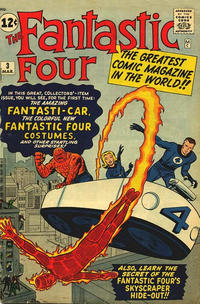
Re-reading the Fantastic Four comics from the start. Issue #3 introduces a lot of what the comic is famous for, along with one of its more obscure villains.
The tale begins with the FF at a magic show. Because why not? The magician calls himself the Miracle Man, and shows his superhuman strength to be far greater than the Thing’s. Reed ruminates on how glad he is that the Miracle Man is not a criminal. Spoke to soon, because the next scene has Miracle Man saying it’s time to throw off his “mask of respectability” and make the world fear him. That’s his motivation, apparently, to demonstrate how powerful he is and make everyone be afraid.
From there, we get the debut of the flying Fantasticar, a great Jack Kirby invention that gives each member of the team his or her own section of the vehicle. We also get the first cutaway of the FF’s headquarters, showing, among other things, a projection room, a conference room, and a photo analysis room. Also at headquarters, Sue debuts the FF’s uniforms, with her saying, “we’re in this business of crime fighting for real!” Before this point, the characters just wore normal clothes. OK, so the story goes that in between the last issue and this one, the folks at DC had introduced the Justice League to great success, and the folks at Marvel felt the pressure to take the FF and make them more traditional superhero-y. I have no idea if that’s true, but the story is out there. (See also: Similarities between the Fantastic Four and DC's Challengers of the Unknown.)
Back to the story, there’s a lot of hype in town over a new movie, THE MONSTER FROM MARS, and a life-size fake monster constructed outside the theater. The Miracle Man shows up and makes the monster come to life, and leads it on a rampage across the city. The monster destroys cars, steals diamonds, and gets caught up in Reed’s body when Reed stretches across to buildings to stop it. The monster then attacks the “local ordinance depot” to steal an atomic tank, only to be stopped by the Human Torch, who burns the monster to the ground, revealing it was made of wood and plaster the whole time. The Miracle Man douses Johnny’s flame with chemical foam (where’d he get that?), and stops Ben by making the ground open up beneath him. Sue, while invisible, sneaks aboard the stolen tank as Miracle Man makes his escape.
Back at headquarters, Johnny and Ben have a pretty nasty argument, ending with Ben wanting to hit Johnny. This isn’t the amusing family bickering that the characters are known for, but more like a “some things can’t be unsaid” type of argument. Elsewhere, At Miracle Man’s hideout, a junkyard, Miracle Man discovers Sue, hypnotizes her so she’s under his command, and has her summon the rest of the team as a trap. The big confrontation begins with a weird scene in which he aims a giant key at our heroes, only to transform it magically into a machine gun. Reed dodges the bullets as a bouncing ball, and the bullets just bounce off of Ben. The Miracle Man takes off in the atomic tank, and Reed, Johnny and Ben follow in an antique roadster which we’re told is stored at the junkyard “between exhibitions.” Your guess is as good as mine. The chase has a funny bit in which Reed stretches himself around one of the wheels as its tire, before Johnny blinds the Miracle Man with a burst bright light from his fire.
As the Miracle Man recovers his sight, Reed deduces the truth. Miracle Man has no supernatural powers, but instead accomplished all this through hypnotism. Wait, what? He hypnotized the entire city, including police and soldiers, into merely thinking they were seeing all this? What did Johnny burn down? What about that tank? Or the stolen jewels? Maybe in the early ‘60s, hypnotism was far-out science, but still. The big deal about the ending isn’t the Miracle Man’s reveal. It’s the comic’s first cliffhanger. As Ben continues to berate Johnny, Johnny up and announces that he’s quitting the team. He flies off, and the others wonder what will become of their little family dynamic.
Unstable molecule: Reed turns himself into a bouncing ball to dodge bullets (would that work?) and the bit where stands in for a tire in the middle of a chase (that’s gotta hurt).
Fade out: Sue does the stealth thing by sneaking into the Miracle Man’s hideout. Too bad she gets caught right afterward.
Clobberin’ Time: Ben pretty much gets his butt handed to him this issue, humiliated and then defeated by the Miracle Man.
Flame on: Johnny saves the day twice in this one, first by destroying the monster and then by blinding the bad guy. Then, after all that, Ben still gives him grief. No wonder he left.
Trivia time: The Miracle Man won’t be seen again until issue #139. He went on to develop actual supernatural powers, only to be killed by the Scourge (“Justice is served!”) and later brought back from the dead in a scheme to take out the Punisher, after which he went back to wallowing in obscurity. This is not the same Miracle Man from the Marvelman/Miracleman legal troubles that have been pockmarking the comic industry for the last couple of years.
Fantastic of Frightful: Nothing about the Miracle Man makes sense, and it’s no wonder he’s not considered a “classic” villain. The meat of the story, though, is the tension between Johnny and Ben, which drives Johnny to quit the team. Going back to those Justice League comparisons, the League of this era were all buddies, so this conflict among the FF must have been something quite surprising for readers of the time. Plus, the group breaks up only three issues in. It’s enough so that you can’t wait to pick up the next issue.
Next week: Here’s Subby!
Like to read? Check out my new book, CINE HIGH, now available for the Kindle and the free Kindle app.
Thursday, July 12, 2012
Fantastic Friday: On aliens, cows, and hypnotism
Re-reading the Fantastic Four comics from the start. Issue #2 introduces the Skrulls.
Once again, the issue begins with several pages of the four characters running around the city, showing off their powers. Only this time, there’s a twist -- the Fantastic Four are committing crimes.
No, turns out it’s the Skrulls, green-skinned aliens who can make themselves look like anyone. They’re using sci-fi doohickeys to mimic the Fantastic Four’s powers, framing them for the Skrulls’ crimes. The Skrulls are doing this because they believe the FF are the only ones who can stop them.
The real FF, for some reason, is staying at a remote hunting lodge. They’re not hiding, because the army shows up at their doorstep to arrest them. The FF surrender and are locked up in special cells, we’re told, that are designed just for them. The army already had these ready to go, did they? Once behind bars, the four escape, trashing the prison in the process (so much for that “surrender” business). They reunite at one of Reed’s “secret apartments” (?) to plot their next move.
Johnny and Ben bicker like crazy, after which it’s decided that Johnny will go undercover, letting the Skrulls think he’s one of them in disguise. Amazingly, it works, and Johnny leads the rest of the four to the Skrulls’ hideout. There, they learn a Skrull armada is in space, ready to attack. Using the same ploy, the other three FFers pretend to be Skrulls as well, and they’re taken into space to meet with the Skrull leader. Reed shows the leader pictures of giant monsters and advanced technology, to scare him off and keep him from invading. Here’s where things get real silly: the pictures are drawings from Strange Tales and Journey Into Mystery – Marvel comics. Even better, the alien warlord actually falls for it! The armada leaves, in fear of the comic book drawings.
The FF head back to Earth, where they still have to deal with both the army and the four Skrulls who initially impersonated them. The Skrulls change into various monstrous forms, only to be defeated by the Fantastic Four. The very trusting army apologizes to Reed and just leaves the Skrulls there with him. Out of nowhere, the Skrulls announce that they don’t what to be Skrulls anymore, so Reed – get this – hypnotizes them into believing they’re cows, allowing them to spend the rest of their days on a peaceful farm. What the heck?
Unstable Molecule: This is more like the Reed I know, saving the day with his awesome smarts and not just his awesome powers. But where’d he get this hypnotism ability from? And scaring off the evil alien leader with comic book drawings? Yeesh.
Fade Out: Aside from freaking out soldiers and a few Skrulls by turning invisible, Sue doesn’t do much in this one.
Clobberin’ Time: Ben actually turns back to human for a few panels during a moment of anguish, something that will happen quite often in these early issues. He also smashes a spiked Skrull monster real good.
Flame on: Johnny gets a lot more to do, thankfully, putting himself on the line for the good of the team. We see some of the famous bickering between him and Ben get its start.
Trivia Time: The Skrulls might have been defeated by comic books and hypnotism, but they nonetheless went on to be major players in the Marvel universe. They had their wars against the Kree, Galactus ate their homeworld, they lost the ability to shapeshift for a while, and, most recently, they almost succeeded in invading the Earth. The cows from this issue even returned in a surprise twist in a later comic.
Fantastic or Frightful? What a silly story. Again, I’m left with the thought that Stan and Jack were making it up on the fly. Kirby’s art is great, though, as this issue gives him a chance to show off alien monsters and spaceships galore.
Next Friday: The Miracle Man!
Like to read? Check out my new book, CINE HIGH, now available for the Kindle and the free Kindle app.
Thursday, July 5, 2012
Fantastic Friday: How long will I keep this up?
I just can’t get those two Fantastic Four movies out of my
system. The two Tim Story flicks just did not do those great characters
justice. Trying to put just how and why into words, though, has been tricky,
and because of that I’ve irked many fans of the movies.
So let’s go back -- all the way back and reread the comics
from the start. Let’s all rediscover what makes the fantastic four so
Fantastic.
I’ll break issues down as such:
Unstable Molecules: Mr. Fantastic’s most memorable moment in
the issue, whether it is due to his stretching powers or his unending genius.
Fade Out: The Invisible Girl’s most memorable moment, either
her invisibility powers, or her role as the heart of the group.
Clobberin’ Time: The Thing’s most memorable scene, which
could be due to his awesome strength, or his contradictory nature as both
misunderstood monster and wisecracking New Yorker.
Flame On: The Human Torch’s most memorable scene, either by use of his fire-based powers, or his fun-loving and sometimes short-tempered personality.
Trivia Time: Random comic facts gleaned from each issue.
Fantastic or Frightful: Final thoughts on each issue.
Time to go all the back to issue number one.
****
Here it is, the very first issue of Fantastic Four. It
covers a lot of ground, as we get to know our heroes, learn their origin, and
then join them on a monster-fightin’ encounter with the Mole Man.
The splash page is interesting for a couple of reasons. For
one, the title “Fantastic Four” is more than just lettering, but actual words
skywritten over the city by one of Reed’s devices. Also, we get headshots of
our four heroes, introduced by their real names. We don’t get their superhero
names until later.
From there, we get something that’s going to be familiar
throughout a lot of these early issues – some excuse for the characters to show
off their powers for a few pages before the plot starts. This time, our heroes
see the words in the sky and respond, making their way from various spots
around town to their headquarters. Sue is shopping, turns invisible, and messes
with people as she does so. Ben, coincidentally, is also shopping, in disguise
beneath a huge trenchcoat. People get a look at him, freak out thinking he’s a
monster, and chase him through the city. It’s even worse for Johnny, who goes
from working on a hot rod in a garage to being chased over the skies in the
city by the air force (!) when all he’s trying to do is get to the meeting.
He’s saved by Reed, conveniently using his powers.
Our four reunited, we get a flashback to the origin. Reed
had designed and built a spaceship and is feeling the pressure to get into the
stars soon. As Sue points out, “We’ve got to take the chance, unless we want
the commies to beat us!” Ben doesn’t want to fly the ship, because he’s
concerned about the cosmic rays, but he does a 180 after Sue calls him a
coward. The four break into the base and sneak onto the ship (I was so looking
forward to this scene in the movie, but no luck). As Ben feared, the cosmic
rays kick in, cause the ship to crash and giving everyone their powers.
Here’s what’s interesting: Ben is actually right, and Reed
is wrong. This leads to the ship crashing and Ben becoming a monster. Then, when
Reed marvels at their new powers, it’s not him but Ben who says they should use
their powers to help mankind. In this sense, some might argue that the Tim Story movie is
accurate in having Reed always screw up and make mistakes. As we’ll see,
though, Reed takes more of an active heroic role in what is to follow.
Back to the present, Reed exposits how energy plants around
the globe are being destroyed. We even see one go down, courtesy of a giant
green monster. Reed deduces that the source of the attacks is the mythical “Monster
Island .” The four travel there on
their private jet, where they’re immediately attacked by a three-headed
monster. This is where Jack Kirby's art really shines in this issue, with the wild-looking
creatures. Reed and Johnny are separated from Sue and Ben. Underground, Reed
and Johnny meet the Mole Man, learning that the villain retired to Monster
Island because he was too ugly to
get a job or a girlfriend. We’ve all been there, bro. A funny scene has the
Mole Man taking down Johnny in hand-to-hand combat, demonstrating his awesome
moves. We don’t see this side of him very often in later encounters. Sue and
Ben, meanwhile, roam the surface, fighting more monsters.
Things end abruptly,
as the Mole Man tries to summon more monsters to attack our heroes, but Johnny
stops them by using his flames to cause a rock slide (?). The four escape,
wondering if the Mole Man survived. You can just tell Stan and Jack had reached the final two pages and had to
scramble to come with an ending at the last minute.
Unstable molecules: Reed turns his arm into a lasso to stop
a monster, and he forms himself into a parachute shape to lower Johnny to
safety (wait… why isn’t Johnny just flying?)
Fade out: Sue turns invisible to confuse a monster as it
attacks.
Clobberin’ Time: Ben has a short but great fight with a rock
monster, ending with him tossing it into the ocean.
Flame on: Aside from somehow causing a rock slide on the
last page, Johnny doesn’t do a whole lot, and mostly screws things up (Whatever
happened to those air force pilots chasing him? Did they just give up?)
Johnny’s more like the other three’s sidekick in this first issue.
Trivia Time: According to one of the cops pursuing Ben, this
isn’t New York , but “Central
City.” No, I don’t know where the Flash is during all this.
Fantastic or Frightful? Everyone loves to go on about how
these silver age comics pack a ton of story into each issue. This one, though,
bites off a little more than it can chew. The big deal about this issue is that
it takes a long time introducing us to our heroes and their origin, which is
good, but then it leaves us with a rushed, abrupt ending, with half the action
described in captions. Now that the introductions are over, though, the real
fun can begin.
Like to read? Check out my new book, CINE HIGH, now available for the Kindle and the free Kindle app.
Thursday, June 7, 2012
No Kindle? No problem.
Here's this, for everyone who's been asking, "What if I don't own a Kindle?" (The app DOES work on a PC and laptop!)
http://www.amazon.com/gp/feature.html/ref=sa_menu_karl3?ie=UTF8&docId=1000493771
Now, even if you don't own a Kindle, you can go ahead and enjoy CINE HIGH.
http://www.amazon.com/gp/feature.html/ref=sa_menu_karl3?ie=UTF8&docId=1000493771
Now, even if you don't own a Kindle, you can go ahead and enjoy CINE HIGH.
Friday, May 25, 2012
CINE HIGH is here, now
Ooohh, yeah, it’s the big day.
CINE HIGH is now available on the Kindle. It’s 99 cents. That’s one-ninth the cost of a BATTLESHIP ticket.
Plot synopsis:
Jack“Joke” McDee cares more about making his classmates laugh than his schoolwork, and his grades show it. On the last week of eighth grade, after Joke does his“clumsy juggler” act on the hood of the principal’s car, he’s nearly run over by a strange girl with a pink motorcycle. She tells him the truth, that he’s not human. He’s the living embodiment of the genre of comedy.
CINE HIGH is now available on the Kindle. It’s 99 cents. That’s one-ninth the cost of a BATTLESHIP ticket.
Plot synopsis:
Jack“Joke” McDee cares more about making his classmates laugh than his schoolwork, and his grades show it. On the last week of eighth grade, after Joke does his“clumsy juggler” act on the hood of the principal’s car, he’s nearly run over by a strange girl with a pink motorcycle. She tells him the truth, that he’s not human. He’s the living embodiment of the genre of comedy.
The girl takes Joke for a ride, transporting him to a strange high school, Cine High, where tough kids Action and Scifi have abducted the teachers and barricaded all the doors. Action and Scifi plan to take over all of entertainment once they graduate, and they’re holding the school hostage until all the other students swear loyalty to them.
Only one other student has the numbers to fight back, Horror. To convince Horror to join his side, Joke journeys from one end of the school to the other throughout the day. The whole time, he wonders, is comedy really the most powerful genre?
CINE HIGH has been an experiment from the beginning. First it was a Twitter novel, and now as an ebook. It’s light, it’s funny, it’s exciting.
So everyone spread the word, and leave one of those cheesy Amazon reviews while you’re at it. Remember, WE ARE THE MEDIA.
Only one other student has the numbers to fight back, Horror. To convince Horror to join his side, Joke journeys from one end of the school to the other throughout the day. The whole time, he wonders, is comedy really the most powerful genre?
CINE HIGH has been an experiment from the beginning. First it was a Twitter novel, and now as an ebook. It’s light, it’s funny, it’s exciting.
So everyone spread the word, and leave one of those cheesy Amazon reviews while you’re at it. Remember, WE ARE THE MEDIA.
Wednesday, May 23, 2012
What is CINE HIGH?
What’s the big blockbuster release on May
25, 2012? Men in Black 3? Pfft, yeah right.
Friday, May 25, is the official pub date for CINE
HIGH!
What
is CINE HIGH? It’s my ebook! Plot synopsis:
Jack
“Joke” McDee cares more about making his classmates laugh than his schoolwork,
and his grades show it. On the last week of eighth grade, after Joke does his
“clumsy juggler” act on the hood of the principal’s car, he’s nearly run over
by a strange girl with a pink motorcycle. She tells him the truth, that he’s
not human. He’s the living embodiment of the genre of comedy.
The girl takes Joke for a ride, transporting him to a strange high school, Cine High, where Action and Scifi, the toughest kids in school, have abducted the teachers and barricaded all the doors. Action and Scifi plan to take over all of entertainment once they graduate, and they’re holding the school hostage until all the other students swear loyalty to them.
Only one other student has the numbers to fight back,
Horror. To convince Horror to join his side, Joke journeys from one end of the
school to the other throughout the day. The whole time, he wonders, is comedy
really the most powerful genre?
It’s
an experiment. I’ve been working on CINE HIGH for about a year and a half. An
earlier draft was “published on Twitter, one sentence at a time, one sentence at
a time, from August to December 2011. That was an experiment, and the ebook is
an experiment as well.
Huge thanks to Erich Asperschlager for the unendingly awesome cover art. Follow Erich on Twitter at @asperslobber.
Hope
you enjoy the book. If you do, spread the word, and take a minute to leave one of
those cheesy Amazon reviews. In this “We are the media” age, every little
word-of-mouth helps.
Sunday, May 20, 2012
Conversation overheard at Best Buy:
BEST BUY EMPLOYEE: "We don't have From Hell, which surprises me, but we have this one. It's really similar. It's a period movie, and Johnny Depp plays a detective.
OLD MAN (to his adult daughter): "Hey, he found this other one with Johnny What's-his-name."
OLD MAN'S ADULT DAUGHTER: "Sleepy Hollow! She doesn't have this one. Dad, she's going to love it."
OLD MAN: "Yeah, OK, let's just pay for it and go."
BEST BUY EMPLOYEE: "We don't have From Hell, which surprises me, but we have this one. It's really similar. It's a period movie, and Johnny Depp plays a detective.
OLD MAN (to his adult daughter): "Hey, he found this other one with Johnny What's-his-name."
OLD MAN'S ADULT DAUGHTER: "Sleepy Hollow! She doesn't have this one. Dad, she's going to love it."
OLD MAN: "Yeah, OK, let's just pay for it and go."
Wednesday, May 2, 2012
Let's do this ebook thaing: The doldrums
The whole
being between drafts thing bugs me. I should be excited – I’m about to put Cine
High on Amazon. It’s my big self-pub experiment. I’m also revising the super top secret project
(Currently on draft number 11) in the hopes of it landing an agent. The most
recent manuscript, Act Four Scene One, will soon begin its own second draft,
probably over the summer, and there’s certainly (hopefully?) a lot of happy
discoveries to be made in that process.
For today, though? I’m not writing. I’m planning
a little here, researching a little there, revising a little there, but not a
lot of “pure creativity” type of work.
Part of my doldrums, I suppose, comes from that
I’m not so much between projects, but between ideas. My head’s full of
characters and plots from stuff I’ve written, but not from what’s new. I
currently have no next story, the one I can’t wait to start working on. There’s
no creative “spark” right now. That’s something anyone can force, I know. I’ve
got to keep doing what I’m doing, trusting that the “spark” will hit again, and
I’ll get all excited about a story again.
Nonetheless, doldrums.
Moving forward: May will be Cine High month,
mark one. On this blog, you’ll get the first glimpse of the cover, your first
look at the story, trivia about the characters and their world, and, of course,
the release day!!!
If I’m really going to do this self-pub thing,
might as well go all out, right?
Tuesday, April 24, 2012
I went to the Boston ComicCon
So I
went to the Boston ComicCon on April 21. First impression: So many people! It
was supposed to open at 10 a.m. I got a slow start on the morning and got there
just before 10, to find the line snaking all the way around the building. I
waited for about an hour before the line started moving and I got in.
Apparently, hours later, there will still people in that line. Around 2-3 p.m.,
I heard people saying, “I’ve been in line all day,” and “I only now just got
in.” Crazy!
Yes, there were quite a few “fight the
crowd” moments when trying to get close up to booths and rifle through the
half-off trades (Drool… half-off trades…), but it wasn’t as bad as it could have
been. At last November’s SuperMegaFest in Framingham, Mass., there were so many
people that you couldn’t walk around, you were just stuck in place with
strangers’ bodies pressing against you (and not in a fun way). So the wide
morass of people at ComicCon was an annoyance, but not so much to ruin the
experience. It’s a weird balancing act with these conventions – too few people
and it’s dreary. Too many people and it’s a pain. You need just the right amount
of people for it to feel lively and fun. Con organizers have no control over
this stuff, so whatever.
After seeing countless online photos of
cosplayers at the San Diego and New York cons, it warms the darkest chambers of
my heart to see the cosplayers in full force in Boston. The standout cosplayer
was the guy dressed as Mr. T. Not just looking the part, but in character the
whole time. This was fun for the first few minutes, but after thatI wanted to
ask him to take his “pity the fool” and “jibber-jabber” act to other side of the
room. The crowds loved him, though. I was excited to see some more obscure
characters represented in cosplay. Dressing up as Batman is one thing, but
walking around in public dressed as Mirror Master? That’s a whole other kind of
personality type. And let’s not forget the slutty female cosplayers. I saw
slutty Emma Frost (redundant?), slutty Batgirl (Stephanie Brown!) and two slutty
Elektras (original, not movie version). Why don’t I have pictures? I could have,
but I didn’t. Too much hassle, even to fumble with the phone, I guess.
Although I did buy my share of half-off
trades (ooohh, half-off trades…), I spent most of the my time – and cash – at
artist’s alley, which, amazingly, covered a good half of the con space. With own
ebook about to come out (Cine High! Cine High! Cine High!), I was naturally
interested in what the self-pubbers have come up with. I picked up comics in
various genres, such as superhero, fantasy, comedy, and even memoir. Great stuff
all around.
Artists like Time Sale, Becky Cloonan, and
Ed McGuiness were there. McGuiness’s line stretched across the con floor. But I
didn’t get in line for their autographs. Somehow, it was enough for me to walk
by and see them there, knowing I’m in the same room as them. I was wicked
excited to meet Jo Chen, cover artist for Runaways, Buffy the Vampire Slayer,
and many other comics. She signed a print of the Runaways #1 cover for me, and
said she loved working on Runaways because they gave her a lot of creative
freedom to do the covers however she wanted. I was also wicked excited to meet
Megan Brennan, co-creator of the webcomic School of World, as her Twitter feed
is always fun and exciting. She and her co-conspirator Rel were very nice and
creeped out by me at all, graciously signing a School of World book for me.
Amid all the hustle and bustle, the biggest
talk around the con was Womanthology, the Kickstarter sensation that has led to
magnificent hardcover collection of work by a variety of female comic creators.
Sadly, every copy sold out almost instantly, so I didn’t get one, but the
message was loud and clear – comics are no longer a boys’ only club. The ladies
have taken the comics world and made it their own. Womanthology was the center
of attention throughout the entire con.
To me, Womanthology means a little more
than gender roles and comics. Womanthology started life with a single Tweet –
140 characters or less – and the whole things snowballed from there, so that the
entire comics industry, if not the internet at large, stood up and took notice.
The Womanthology creators are doing their own things, and the audience generates
itself. I’m excited about that. It seems to me that this type of success is open
to any writer or artist, of course. As Cine High is about be unleashed unto an
unexpecting world, I’m well aware that sales may never rise higher than 20, or
it might go viral and make billions upon billions of dollars. I just don’t know.
If Womanthology started with a single Tweet, then it seems to me that any
self-pubbed project has the same chance.
Friday, April 20, 2012
Thursday, April 19, 2012
Let's do this ebook thaing: Platform, platform, platform
Great. I started a blog, and then haven’t posted on it since forever. I’ve become that guy who does that.
Platform, platform, platform, platform. Basically, the author’s platform is his or her version of “why you should buy my crud.” For nonfiction authors, this means demonstrating why you’re an expert in your subject matter. For fiction authors, it means having a personality.
The “author blog” thing seems backwards to me. Shouldn’t it be that a reader likes the book, and then tracks down the author to learn more? Instead, it’s the reader wants to learn more about the author before committing to buy the $1-3 (or free) self-pubbed ebook. Therefore, this blog is now officially a thing.
Well no more, because Cine High is about to be released as an ebook, and, as the author, I somehow have to become obsessed with my “platform.”
Platform, platform, platform, platform. Basically, the author’s platform is his or her version of “why you should buy my crud.” For nonfiction authors, this means demonstrating why you’re an expert in your subject matter. For fiction authors, it means having a personality.
I’m trying really, really hard to have a personality. No, really.
The “author blog” thing seems backwards to me. Shouldn’t it be that a reader likes the book, and then tracks down the author to learn more? Instead, it’s the reader wants to learn more about the author before committing to buy the $1-3 (or free) self-pubbed ebook. Therefore, this blog is now officially a thing.
Where do I get off calling myself an author? Cine High will be available for the Kindle in a matter of weeks. Keep watching this site for more on what its about and when you’ll be able to read and enjoy it.
And… we’re done. Author’s blog.
Friday, January 27, 2012
Here's where I'm at
Here's where the writing is currently at:
Manuscripts one and two are on the back burner.
Manuscript three is going though the query process and is currently being read for an upcoming consult.
Manuscript four is the Twitter novel CINE HIGH, which is being revised in the hopes of turning it into an ebook.
And now I have an outline going for a first draft of manuscript number five, a story I'm really excited about.
I really have lost my mind, haven't I?
Manuscripts one and two are on the back burner.
Manuscript three is going though the query process and is currently being read for an upcoming consult.
Manuscript four is the Twitter novel CINE HIGH, which is being revised in the hopes of turning it into an ebook.
And now I have an outline going for a first draft of manuscript number five, a story I'm really excited about.
I really have lost my mind, haven't I?
Monday, January 9, 2012
Subtleties, subtitles and SUPER 8
Now, I wasn’t as slobberingly in love with SUPER 8 as some others, proclaiming it to be the second coming of classic Spielberg fantasy, but I did enjoy the movie quite a lot. That enjoyment was enhanced when I got the Blu-ray. Watching a movie with the subtitles sometimes reveals little details that you might miss the first time around, and that’s the case big time with SUPER 8. Take a closer look at the scene in which the kids first ride off into the night to film their movie, just before the big train crash that kicks off the plot. This is where our heroes Joe and Alice first meet, or at least first get to know each other. The romantic tension between the two is evident. What’s less evident is how there is more than one level of story at work here, and how the disc’s subtitles show how the scene takes into the characters’ heads, without us even realizing it.
After everyone gets out of the car, Charles states, “Guys this is going to be great,” and he immediately launches into director mode, talking about shooting in two directions. Here is a little clue that this scene we're watching is about to go in two directions.
Next, Charles speaks to his lead actor, saying he wrote a new line, saying “It’s going to be awesome,” and then promising “It’s not going to be hard.” It’s right on that last beat that Joe first approaches Alice , to do her makeup. Why is that significant, because it’s as if the line “It’s not going to be hard,” reflects Joe’s state of mind as he approaches her, telling himself not to be fearful.
Joe asks, “Do you mind?” in reference to the makeup. Before she answers, Charles, unseen from behind her says, “You know that part where you say…” and then she answers, “No.” Charles’s line could be read in context of her inner monologue, as she tells herself it’s OK to talk to Joe, despite their shared history, so no, she doesn’t mind.
As Alice pulls her hair back to better let Joe apply the makeup, Charles behind her says the old line is gone, replaced by one that is better. “I just need this one,” he says. Joe then finishes the makeup and says, “There. Thanks.” If we’re to take Charles’s words as doubling for Joe and Alice ’s inner thoughts, then “this one” is Alice ’s gesture of pulling her hair back, a small act, but one that brings them some comfort with each other.
Joe continues to apply the makeup, as Charles stresses to his actor that the new lines are “Honey, I love you,” and “I love you, too.” Charles repeats these several times in the background as Joe and Alice ’s eyes meet. Once more, Charles is speaking what Joe and Alice are feeling – or, in this case, want to be feeling – at that moment. Matters of the heart are never so simple, though, especially given Joe and Alice’s history. Charles’s actor says, “You keep changing things and making it more difficult for me,” while Charles insists that all he has to say is, “I love you, too.” This dialogue goes on as Joe silently applies the makeup, further illustrating what he and Alice are thinking without them having to say it.
Charles next says, “It’s like four words,” but Alice breaks the tension with six instead, saying, “My dad works at the mill.” This addresses the billion-pound elephant in the room, addressing the parental issues keeping them apart. Joe’s face goes blank as he doesn’t know how to respond, while Charles fills us in on his emotional stress, by asking, “Can you say I love you?” Joe doesn’t say it though, even though he wants to, and instead asks Alice to close her eyes. This is something of a symbolic gesture, as if trying to blind themselves from how they’re starting to feel about each other.
Finally, Charles simultaneously concludes and segues into the next story beat by saying, “So this scene is very emotional.” He’s talking not just about what he and his buddies are about to film, but, in subtext, about what we’ve just seen.
There are a lot of little details like this throughout SUPER 8, making it rewatchable, along with all explosions and alien craziness, of course.
Sunday, December 18, 2011
I can't stop thinking about TRON: LEGACY
I can’t stop thinking about TRON: LEGACY.
Part of the reason for this is because I’m a big TRON fan from way back, having had my mind blown by seeing the original on the big screen when I was a kid. So I’m hard wired to enjoy light cycles, disc battles, and lines of dialogue like “Bring forth the logic probe.” The new TRON gives us all that, and it’s a lot of fun revisiting good ol’ Kevin Flynn, and that whacked out computer world. Yeah, it’s fun, but that’s not why I can’t stop thinking about TRON: LEGACY. Many people will choose to view the movie as “retro,” but, for me, it’s the opposite. For me, TRON: LEGACY represents the future.
Future shock 1: Free info
In the first third of the movie, before we get into the funky computer world, we first have to deal with the pesky human world. It’s here that we get an interesting vignette. The snotty bureaucrats that run the fictional Encom Company are about to release an operating system for extreme profits, despite Alan Bradley’s insistence that Flynn wanted it to be free for all. The sniveling bureaucrats ignore Alan’s noble ideals and instead roll out their apparently greedier plan. Enter our hero, Sam Flynn, who takes a stand for free information, screwing with Encom, putting the new O.S. on the web free for anyone who wants it, embarrassing the slimy bureaucrats as he does so. Plotwise, this establishes Sam as a combination of daredevil and idealist, and it helps us buy his “reckless choices with noble intent” actions that come into play later in the movie. This also reflects the changing of the times we’re currently experiencing. Everyone looks to the web for free media. Watch movies online! Watch your favorite TV shows online! Get the news online! Play games online! Instant this! Instant that! Instant! Instant! Instant!
Those in the so-called “traditional media” are terrified of this, but the mind-boggling success of sites like Facebook shows that free media and financial survival – if not success – is possible. (Though I’m still unclear as to how, exactly, Facebook made all its billions. I guess if I could answer that, then I’d be the one invented Facebook, right?) Anyway, Sam’s stand for free media, giving a metaphorical middle finger to the sterile bureaucrats as he does so, points a huge arrow in the direction that the world’s media is headed toward.
Future shock 2: The ISOs
TRON: LEGACY introduces some fascinating concepts, in between light cycle chases and flamboyant nightclub owners. You have “the grid,” which the fantastical TRON world, populated by programs instead of people. This is part of the novelty of the original TRON we all so fondly remember, but TRON: LEGACY takes it a step farther by asking, what’s beyond the grid? The logical part of the mind says there’s nothing beyond the grid. The creative part of the mind dictates that beyond the grid exists untapped potential, like a blank canvas, or, perhaps more appropriately, unused disc space – it could be used for anything you want. It’s in this unused/untapped space that Flynn makes his home in TRON: LEGACY, partially to stay hidden from the movie’s villain, but also to expand his own consciousness, via what he calls his “Zen master thing.” We’re told in a flashback that Flynn, Tron, and Flynn’s digitized counterpart Clu sought to recreate the Grid into a better, arguably perfect world. It’s outside the grid, though, where Flynn strives for inner peace, turning peace and perfection inward to his own self, rather than to the world around him.
It’s also outside the grid that we’re introduced to the ISOs, short for “isomorphic algorithms.” Who are they? The movie states that they are “self-produced programs that spontaneously evolved in the system, which carried the potential to unlock mysteries in science, religion, and medicine.” I don’t know about you, but I find this fascinating. In recent years, a lot of folks in the science fiction community have balked against the idea of life on other planets, alleging that inarguable mathematics prove that intelligent life does not exist anywhere else in the universe (What if you forgot to carry the one?) and therefore, the so-called experts say, no science fiction story should ever, ever, ever, again feature aliens from other planets, no matter how cool or fun those aliens might be. This line of thought has led to silliness like those lines about “the spaces in between” from INDIANA JONES AND THE KINGDOM OF THE CRYSTAL SKULL, as if to sell us on the idea that it’s more mathematically realistic for aliens to be from an alternate dimension than from another planet. I find this ridiculous, as grey-skinned aliens in a flying saucer are still aliens in a flying saucer, and who the hell cares how “realistic” that is?
This brings us back to TRON: LEGACY, which comes up with an altogether new idea. Here we have the ISOs, alien life that emerged seemingly from out of nowhere from beyond the grid. Who are they? Where did they come from? The movie doesn’t provide concrete answers, but what it leaves open to speculation is fascinating. TRON: LEGACY posits that contact with alien life forms will not be from other planets or other dimensions. Instead, we’re introduced to living beings made of pure information. After all, what is information, in a physical sense? It is electricity and light, transmitted from computer to computer, appearing on screen after screen. Both light and electricity are physical matter – we know this because both are affected by gravity. If the impulses of light and electricity at specific frequencies and/or intervals make up what we know as information, than who’s to say that information can’t grow, or, dare I say, evolve, into something far more complex, to the point where raw digital information becomes a life form of its own? Personally, in the future I envision, contact with alien life might just come from digital worlds we create and lose control of, rather than other worlds (I also believe extending our own humanity to life on other planets is integral to our survival, and that our life forms made of pure information could help us make that possible, but that’s an article for another time).
The ISOs of TRON: LEGACY are, to me, a more believable alien life form than any space aliens or alternate dimension goatee-wearers we’ve seen before. Even though I love freaky space aliens in sci-fi flicks, TRON: LEGACY says to something more. There’s a moment in TRON: LEGACY in which Flynn and Sam “hack” into Qurra, an ISO, and her disc, briefly revealing a three-layer DNA strand, as opposed to a regular human two-layer strand. How advanced she is, far beyond either program or user. Seeing this, all I can think is, this is where the future is headed.
Future shock 3: The face of Clu
It seems that any movie made during the 70s or 80s that used any sort of computer graphics, including TRON, claims to be the “first” to use CGI. For years, I believed that RETURN OF THE JEDI was the first to use CGI, but that was a year before TRON. THE LAST STARFIGHTER’s funky computer effects lay claim to be the first, but it was two years after TRON. Before TRON, things get even more sketchy. THE GREAT MOUSE DETECTIVE, in 1986, also claims to be the first use of CGI in a movie, as does the cheesy 1976 sequel FUTUREWORLD. FUTUREWORLD’s predecessor WESTWORLD, also allegedly used some fleeting computer graphics, way back in 1973. So who was really this first? The debates among movie fans will never end.
Whether it was truly first, the original TRON, will always lay claim as an effects groundbreaker, because it had both computer effects and a computer-related storyline. First or not, TRON broke ground in special effects technology, creating visuals the likes of which have never been seen before since, not to mention those unendingly cool light cycles.
So, in 2010, when the time came to make TRON: LEGACY the creators are faced with an unusual challenge. In an age in which CGI makes any far-our fantasy worlds possible, how do you break new ground? Answer: You do the one thing that everyone says CGI can’t do – you do a CGI human.
Ever since the mid-90s, when CGI took off in a big way, everyone has pretty much agreed that despite everything CGI can do, it can’t recreate an actual human. Director Robert Zemekis gave it a halfway decent try with THE POLAR EXPRESS and BEOWULF, but those characters, stiff and glass-eyed as they were, were still fairly exaggerated (I dare you to rewatch BEOWULF and try to convince yourself that those “realistic humans” aren’t overly exaggerated. I dare you.) TRON: LEGACY goes father – a lot farther. The filmmakers have attempted what everyone in the world says is impossible – a CGI human. Can’t be done, you say? You could make that case, and yet, there’s Clu, front and center throughout the entire movie.
The original TRON might not have been the first move to use CGI, but it was certainly one of the first to gain notice for CGI used in a big way. In 1982, TRON set its foot down and said to the world “Computers are the future.” Then, in 2010, the creators of TRON: LEGACY did a comparable act, slamming their foot down and saying, “That what everyone says can’t be done? We’ve done it.” Or, at least, they’ve attempted it, more than anyone else has done. They went where all other filmmakers and special effects artists have never gone – that, to me, represents the future.
Is Clu a perfect effect? No. For that matter, is the brief glimpse of “young Flynn” in the real world a seamless effect? No. The human eye can tell it’s an effect. That said, turn the clock back to 1982. Are the CGI effects of the original TRON photo-real? Of course not. Are the images of light cycles and returners mesmerizing, and do they draw you into the story and into the fantastical world the filmmakers have created? Yes, yes they do. It’s the same thing – the special effects of the original TRON might be rough by today’s standards, but they were beyond what anyone else at the time had ever created. Those visuals might not have been first, but they represented the next step. In TRON: LEGACY, Clu might not be a seamless effect, but he represents what no other filmmakers dared attempt. What everyone else said was impossible is what TRON: LEGACY put on screen. Clu isn’t perfect, we can all agree on that, but just like the original TRON showed us where movie visuals would eventually go, I can’t help wonder if TRON: LEGACY is providing a similar road map to the future of animation and filmmaking.
Future shock: The 80s
Why do I love 80s stuff? All the neon, the sharp angles, the weirdness for weirdness sake in pop culture of the time, it was all about looking ahead, to the future. Yeah, 1960s retro was pretty big in the 80s, but even that was about taking the ideals of societal change and bringing them from the 60s into the modern time with a modern sensibility, working toward a brighter future, especially in the shadow of movements such as glasnost and perestroika. Then, along came the 90s, and suddenly everything was about retro. Fashion and pop culture became obsessed with reliving the past, even when faced with the rise of the internet and Y2K hysteria.
Throughout the years, however, TRON refused to be retro. TRON continues to represent the future, and where we’re headed, rather than where we’ve been, and TRON: LEGACY continues that trend. It has the light cycles and disc battles and arcades with Journey music to satisfy the nostalgia crowd, and that’s all great fun, but by the time the credits roll, TRON: LEGACY joins its predecessor as a movie that represents the future.
That’s why I can’t stop thinking about TRON: LEGACY.
(Originally posted on the DVD Verdict judges' blog.)
Part of the reason for this is because I’m a big TRON fan from way back, having had my mind blown by seeing the original on the big screen when I was a kid. So I’m hard wired to enjoy light cycles, disc battles, and lines of dialogue like “Bring forth the logic probe.” The new TRON gives us all that, and it’s a lot of fun revisiting good ol’ Kevin Flynn, and that whacked out computer world. Yeah, it’s fun, but that’s not why I can’t stop thinking about TRON: LEGACY. Many people will choose to view the movie as “retro,” but, for me, it’s the opposite. For me, TRON: LEGACY represents the future.
Future shock 1: Free info
In the first third of the movie, before we get into the funky computer world, we first have to deal with the pesky human world. It’s here that we get an interesting vignette. The snotty bureaucrats that run the fictional Encom Company are about to release an operating system for extreme profits, despite Alan Bradley’s insistence that Flynn wanted it to be free for all. The sniveling bureaucrats ignore Alan’s noble ideals and instead roll out their apparently greedier plan. Enter our hero, Sam Flynn, who takes a stand for free information, screwing with Encom, putting the new O.S. on the web free for anyone who wants it, embarrassing the slimy bureaucrats as he does so. Plotwise, this establishes Sam as a combination of daredevil and idealist, and it helps us buy his “reckless choices with noble intent” actions that come into play later in the movie. This also reflects the changing of the times we’re currently experiencing. Everyone looks to the web for free media. Watch movies online! Watch your favorite TV shows online! Get the news online! Play games online! Instant this! Instant that! Instant! Instant! Instant!
Those in the so-called “traditional media” are terrified of this, but the mind-boggling success of sites like Facebook shows that free media and financial survival – if not success – is possible. (Though I’m still unclear as to how, exactly, Facebook made all its billions. I guess if I could answer that, then I’d be the one invented Facebook, right?) Anyway, Sam’s stand for free media, giving a metaphorical middle finger to the sterile bureaucrats as he does so, points a huge arrow in the direction that the world’s media is headed toward.
Future shock 2: The ISOs
TRON: LEGACY introduces some fascinating concepts, in between light cycle chases and flamboyant nightclub owners. You have “the grid,” which the fantastical TRON world, populated by programs instead of people. This is part of the novelty of the original TRON we all so fondly remember, but TRON: LEGACY takes it a step farther by asking, what’s beyond the grid? The logical part of the mind says there’s nothing beyond the grid. The creative part of the mind dictates that beyond the grid exists untapped potential, like a blank canvas, or, perhaps more appropriately, unused disc space – it could be used for anything you want. It’s in this unused/untapped space that Flynn makes his home in TRON: LEGACY, partially to stay hidden from the movie’s villain, but also to expand his own consciousness, via what he calls his “Zen master thing.” We’re told in a flashback that Flynn, Tron, and Flynn’s digitized counterpart Clu sought to recreate the Grid into a better, arguably perfect world. It’s outside the grid, though, where Flynn strives for inner peace, turning peace and perfection inward to his own self, rather than to the world around him.
It’s also outside the grid that we’re introduced to the ISOs, short for “isomorphic algorithms.” Who are they? The movie states that they are “self-produced programs that spontaneously evolved in the system, which carried the potential to unlock mysteries in science, religion, and medicine.” I don’t know about you, but I find this fascinating. In recent years, a lot of folks in the science fiction community have balked against the idea of life on other planets, alleging that inarguable mathematics prove that intelligent life does not exist anywhere else in the universe (What if you forgot to carry the one?) and therefore, the so-called experts say, no science fiction story should ever, ever, ever, again feature aliens from other planets, no matter how cool or fun those aliens might be. This line of thought has led to silliness like those lines about “the spaces in between” from INDIANA JONES AND THE KINGDOM OF THE CRYSTAL SKULL, as if to sell us on the idea that it’s more mathematically realistic for aliens to be from an alternate dimension than from another planet. I find this ridiculous, as grey-skinned aliens in a flying saucer are still aliens in a flying saucer, and who the hell cares how “realistic” that is?
This brings us back to TRON: LEGACY, which comes up with an altogether new idea. Here we have the ISOs, alien life that emerged seemingly from out of nowhere from beyond the grid. Who are they? Where did they come from? The movie doesn’t provide concrete answers, but what it leaves open to speculation is fascinating. TRON: LEGACY posits that contact with alien life forms will not be from other planets or other dimensions. Instead, we’re introduced to living beings made of pure information. After all, what is information, in a physical sense? It is electricity and light, transmitted from computer to computer, appearing on screen after screen. Both light and electricity are physical matter – we know this because both are affected by gravity. If the impulses of light and electricity at specific frequencies and/or intervals make up what we know as information, than who’s to say that information can’t grow, or, dare I say, evolve, into something far more complex, to the point where raw digital information becomes a life form of its own? Personally, in the future I envision, contact with alien life might just come from digital worlds we create and lose control of, rather than other worlds (I also believe extending our own humanity to life on other planets is integral to our survival, and that our life forms made of pure information could help us make that possible, but that’s an article for another time).
The ISOs of TRON: LEGACY are, to me, a more believable alien life form than any space aliens or alternate dimension goatee-wearers we’ve seen before. Even though I love freaky space aliens in sci-fi flicks, TRON: LEGACY says to something more. There’s a moment in TRON: LEGACY in which Flynn and Sam “hack” into Qurra, an ISO, and her disc, briefly revealing a three-layer DNA strand, as opposed to a regular human two-layer strand. How advanced she is, far beyond either program or user. Seeing this, all I can think is, this is where the future is headed.
Future shock 3: The face of Clu
It seems that any movie made during the 70s or 80s that used any sort of computer graphics, including TRON, claims to be the “first” to use CGI. For years, I believed that RETURN OF THE JEDI was the first to use CGI, but that was a year before TRON. THE LAST STARFIGHTER’s funky computer effects lay claim to be the first, but it was two years after TRON. Before TRON, things get even more sketchy. THE GREAT MOUSE DETECTIVE, in 1986, also claims to be the first use of CGI in a movie, as does the cheesy 1976 sequel FUTUREWORLD. FUTUREWORLD’s predecessor WESTWORLD, also allegedly used some fleeting computer graphics, way back in 1973. So who was really this first? The debates among movie fans will never end.
Whether it was truly first, the original TRON, will always lay claim as an effects groundbreaker, because it had both computer effects and a computer-related storyline. First or not, TRON broke ground in special effects technology, creating visuals the likes of which have never been seen before since, not to mention those unendingly cool light cycles.
So, in 2010, when the time came to make TRON: LEGACY the creators are faced with an unusual challenge. In an age in which CGI makes any far-our fantasy worlds possible, how do you break new ground? Answer: You do the one thing that everyone says CGI can’t do – you do a CGI human.
Ever since the mid-90s, when CGI took off in a big way, everyone has pretty much agreed that despite everything CGI can do, it can’t recreate an actual human. Director Robert Zemekis gave it a halfway decent try with THE POLAR EXPRESS and BEOWULF, but those characters, stiff and glass-eyed as they were, were still fairly exaggerated (I dare you to rewatch BEOWULF and try to convince yourself that those “realistic humans” aren’t overly exaggerated. I dare you.) TRON: LEGACY goes father – a lot farther. The filmmakers have attempted what everyone in the world says is impossible – a CGI human. Can’t be done, you say? You could make that case, and yet, there’s Clu, front and center throughout the entire movie.
The original TRON might not have been the first move to use CGI, but it was certainly one of the first to gain notice for CGI used in a big way. In 1982, TRON set its foot down and said to the world “Computers are the future.” Then, in 2010, the creators of TRON: LEGACY did a comparable act, slamming their foot down and saying, “That what everyone says can’t be done? We’ve done it.” Or, at least, they’ve attempted it, more than anyone else has done. They went where all other filmmakers and special effects artists have never gone – that, to me, represents the future.
Is Clu a perfect effect? No. For that matter, is the brief glimpse of “young Flynn” in the real world a seamless effect? No. The human eye can tell it’s an effect. That said, turn the clock back to 1982. Are the CGI effects of the original TRON photo-real? Of course not. Are the images of light cycles and returners mesmerizing, and do they draw you into the story and into the fantastical world the filmmakers have created? Yes, yes they do. It’s the same thing – the special effects of the original TRON might be rough by today’s standards, but they were beyond what anyone else at the time had ever created. Those visuals might not have been first, but they represented the next step. In TRON: LEGACY, Clu might not be a seamless effect, but he represents what no other filmmakers dared attempt. What everyone else said was impossible is what TRON: LEGACY put on screen. Clu isn’t perfect, we can all agree on that, but just like the original TRON showed us where movie visuals would eventually go, I can’t help wonder if TRON: LEGACY is providing a similar road map to the future of animation and filmmaking.
Future shock: The 80s
Why do I love 80s stuff? All the neon, the sharp angles, the weirdness for weirdness sake in pop culture of the time, it was all about looking ahead, to the future. Yeah, 1960s retro was pretty big in the 80s, but even that was about taking the ideals of societal change and bringing them from the 60s into the modern time with a modern sensibility, working toward a brighter future, especially in the shadow of movements such as glasnost and perestroika. Then, along came the 90s, and suddenly everything was about retro. Fashion and pop culture became obsessed with reliving the past, even when faced with the rise of the internet and Y2K hysteria.
Throughout the years, however, TRON refused to be retro. TRON continues to represent the future, and where we’re headed, rather than where we’ve been, and TRON: LEGACY continues that trend. It has the light cycles and disc battles and arcades with Journey music to satisfy the nostalgia crowd, and that’s all great fun, but by the time the credits roll, TRON: LEGACY joins its predecessor as a movie that represents the future.
That’s why I can’t stop thinking about TRON: LEGACY.
(Originally posted on the DVD Verdict judges' blog.)
Friday, December 9, 2011
I actually watched Transformers 3
Here's what I posted on Twitter as I made my way through the madness known as TRANSFORMERS: DARK OF THE MOON:
* OK, Michael Bay, try to impress me.
* I love that Hasbro is the first name in the credits. That tells you just what kind of movie this is going to be.
* We get a glimpse of Cybertron and... it looks like Zion from the Matrix sequels. Shaking my head.
* Alterna-NASA sci-fi stories have never excited me. Real NASA is already cool enough.
* Hot girlfriend, hangs out at the White House... Sam isn't exactly the "guy next door" anymore, is he?
* Great, more Michael Bay "comedy." Just because you can have wacky sidekicks doesn't mean you should.
* This was originally released in 3-D, right? That's why a lot of these scenes are all grey and colorless?
* Shockwave was the first Transformer I ever owned. That thing with the tentacles is NOT Shockwave.
* It's a BURN AFTER READING reunion.
* Too... many... silly... accents...
* Subplot about Sam, his girlfriend, and his girlfriend's boss seems pointless. It better be going somewhere.
* On the positive side, Megatron's finally showing a little bit of personality for once in these movies.
* Michael Bay, even with Ken Jeong in your movie, you still can't do comedy. Just STOP.
* The movie is spinning its wheels, so to speak. A lot of talk, exposition, forced conflict, forced comedy. I'm bored.
* Suddenly, it's a gangster flick. Why aren't the transformers in this Transformers movie?
* It's Spider-Man's landlord!
* Robot fightin'! But the robots all look alike, so I can't tell which is which. I should be pumped, but I'm confused.
* What? Optimus just stands there and lets the villain walk away? And now we're at a fancy dinner party? Ugh.
* What should be a suspenseful twist is instead an excuse for Sam to do slapstick shtick. Ugh again.
* Didn't the second movie also do the "Oh, no, Optimus is dead for real" fake-out? Why do it again?
* What's with all the cuts to a black screen, and then back to the action? It's like they're still editing the trailer.
* Suddenly I'm watching BATTLE: L.A. Why can't this movie make up its mind what it wants to be?
* The Decepticons don't have phones? They communicate only by yelling at each other?
* "Boomsticks?" Seriously? Now I'm wishing I was watching ARMY OF DARKNESS instead.
* Now someone just yelled, "Shoot the glass," and suddenly I wish I was watching DIE HARD.
* Nothing says "Hollywood blockbuster" like the single-tear-falls-down-the-hero's-face shot.
* Sam has parkour moves now? Since when?
* "You'll have to go through me." That's it, keep the action cliches coming, movie.
* The final confrontation started with, "Holy crap!" but quickly sank back down to "Oh, brother."
Monday, December 5, 2011
Let's do this ebook thaing: Where are the Smashwords readers?
It’s time to turn CINE HIGH into an ebook. What’s CINE HIGH? It’s the book I wrote. (It’s my fourth book, but we’ll ignore those first three for now.)
I “published” the entire novel on Twitter, sentence by sentence, from Aug. 6 to Dec. 5, 2011 . My readers were small – infinitesimal by Twitter standards – but loyal, so I’d consider that experiment a success.
Now, an ebook. I’m learning as I go, so I’m going to blog about it as I go. Because I’m a total internet guy now and that’s what internet guys do.
Today’s bit of research was an initial foray into Smashwords. Looks like a fun site, lots of books to peruse, with publishers and self-publishers side-by-side. I can see why so many self-publishers are attracted to the site, as it has an attractive “publish with us” link in a prominent, easy-to-spot place.
Here’s my question: What about the readers? How many readers are getting their books from Smashwords? I hear people all the time talking about books they got from Amazon, about self-published books they found on Amazon for their Kindles, I hear about self-publishers making their books available as PDFs on their own sites, but I never hear, “I found this great book on Smashwords, you have to check out.” I also never hear, “Oh, man, all those books on Smashwords are awful.” In other words, all the talk about Smashwords comes from the writers and the publishers, but never the readers. Are the readers there? If so, they’re not making their presence known.
(Side note: Dictionary.com informs me that one of the definitions of “infinitesimal” is, “pertaining to, or involving infinitesimals.” I find that hilarious for some reason.)
Sunday, October 2, 2011
Great, now he's blogging.
Don't you hate how first posts on blogs are so boring and pointless? Glad this one's over.
Subscribe to:
Posts (Atom)


